
How Syracuse built a multi-institutional model for tracking collaboration, influence and growth using Dimensions
Syracuse University needed a reliable way to evidence the impact of its interdisciplinary research institutes. Existing systems could not capture outputs from partner organizations, and manual analytics created inconsistent reporting. Working with Dimensions, Syracuse developed a repeatable approach that unifies data across institutions, surfaces collaboration patterns and reveals emerging research themes. The model has the potential to inform leadership decisions and strengthen the university’s position for major grant applications.
“By leveraging the right tools and partnerships, we’re setting the stage for other institutes to measure and showcase their impact effectively.”
– Emily Hart, Science Librarian and Research Impact Lead, Syracuse University
Interdisciplinary research is transforming how universities address complex challenges, but measuring its impact remains a challenge. Emily Hart, the Science Librarian and Research Impact Lead at Syracuse University Libraries, is spearheading efforts to establish meaningful metrics for interdisciplinary research.
“One of the ways Syracuse University is growing its research presence is through interdisciplinary centers and institutes,” she explains. Her focus is on measuring the collective impact of these institutes – such as the university’s BioInspired Institute, which brings together researchers from engineering, physics, biology, chemistry, and other disciplines to address complex challenges.The BioInspired Institute also collaborates with neighboring institutions, such as SUNY College of Environmental Science and Forestry and Upstate Medical University. This makes it a unique, multi-institutional endeavor. Emily’s role involves demonstrating the value of these collaborations by analyzing and visualizing research outputs and their broader impact.
The assessment gap
Despite its potential, the BioInspired Institute faced challenges in articulating its contributions. “The university doesn’t yet have a standard framework for evaluating interdisciplinary research,” Emily shares. Annual reporting requirements and efforts to secure large institutional grants demanded consistent and meaningful metrics – but existing tools like Syracuse’s Research Information Management System couldn’t capture data from partner institutions, and few people had the technical skills to handle APIs and advanced data visualization.
“So we were wrestling with a lot of questions,” Emily continues. “How do you establish what those consistent metrics are for an interdisciplinary institute? How do you show the impact they’re having on a particular group of people on campus? What topics are being researched? Where are they publishing and what attention is their research getting? Who’s collaborating within the institute and externally? And critically, has collaboration within the institute increased since its inception? But we lacked the capacity and expertise to dig deep into the data, and that was really holding us back.”
Building the right framework
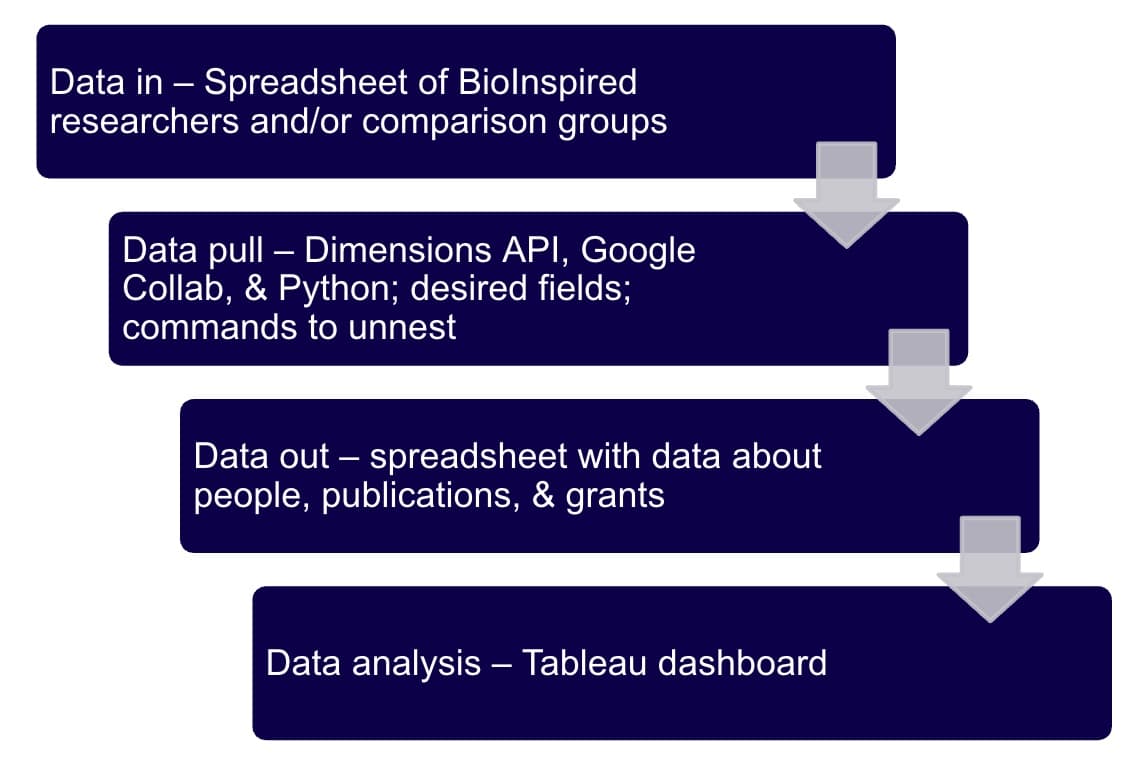
The breakthrough came via a collaboration with Dimensions and the expertise of Emily Koechel, one of the platform’s technical consultants. “We worked very closely with her and it’s been a really fun and fantastic project,” enthuses Emily. Her team, including a graduate student skilled in Python and data visualization, leveraged Dimensions’ API to extract and analyze publication data.
Insight that leadership can use
Using Tableau, the team created visualizations to track collaboration and publication trends. One analysis compared pre- and post-institute collaboration, revealing an increase in co-authored publications and citations. Another visualization identified key research concepts, such as extracellular matrix studies, helping the institute strategize future collaborations.
“We mapped BioInspired faculty to Dimensions researcher IDs, which allowed us to query the database and unnest detailed data for deeper analysis.”
(Top #) Number of Publications Co-Authored by 2 or More BioInspired Researchers Pre & Post Institute Formation (pre-institute 2013 – 2018, post-institute 2019 – August, 2024)

(Bottom #) The total number of citations received by the co-authored publications.
A robust model for the future
This pilot project has already yielded actionable insights, but Emily is looking ahead. “A major next step is transitioning this process to the BioInspired Institute itself,” she shares. Using the Dimensions API to automate data pulls will allow institutes to generate reports independently, ensuring both scalability and sustainability.
Emily reflects on the journey. “This project has been a learning experience in building metrics for interdisciplinary research. By leveraging the right tools and partnerships, we’re setting the stage for other institutes to measure and showcase their impact effectively.” Syracuse University’s efforts serve as a model for other institutions navigating the complexities of interdisciplinary research assessment.
Watch the full session with Syracuse University
Find out what Dimensions can do for you
Interested in how Dimensions can help you measure your research impact? Talk to our team.